


Keeping Beehives on our Homestead
We Love Keeping Beehives
A Homesteader’s Guide to Honey Bees
As part of our goal to take our 17 acres and turn it into a Homestead we added some beehives. This addition was planned, but the timeline got bumped up when a friend of ours acquired some established hives. “Cool, we’ll figure it out.” Little did we know what we got into. We thought, sure, get some hives and let the bees do their thing and then we’ll get honey. Not so fast, hive inspections, queen cells, honey bound and what the heck are varroa destructor mites! It quickly became clear we needed to learn some stuff.
As we continue to figure it out, bees have become one of the enterprises we have set as a profit center goal. What we have discovered is honey bees may be small, but their impact on the planet is huge. Keeping beehives isn’t just about harvesting honey and beeswax to us any longer, it’s also about supporting biodiversity, protecting food security, and contributing to a balanced ecosystem. And of course, pollinating our flower and vegetable gardens as well. Whether you’re a homesteader or a suburban gardener, here’s what we have learned and why keeping beehives on our property is important to us… hope it’s helpful.
Table of Contents
- Why Are Bees Important
- Honey Bees and Beehives
- Our Goals for Keeping Beehives on our Homestead
- Beekeeping Equipment
- Getting Started with Beekeeping: Hive to Honey
Why Are Bees Important
Bees are important to ecosystems for one reason, Pollination. Yes, we love our honey and other products, but at the end of the day bees have a much more important job than keeping our honey supers full. Bees are responsible for pollinating over 70% of the crops that feed us. Without bees our food system would collapse. As beekeepers, we get a front-row seat to see how these tireless workers impact our land, our food, and our future. We also see the never-ending onslaught of challenges our little friends face.
What is Pollination
Pollination is simply the process of pollen being transferred from the male part of a flower (the anther) to the female part (the stigma), enabling fertilization and the production of seeds. In simpler terms, it’s how plants reproduce and create fruits, vegetables, and seeds. Some plants can self-pollinate or rely on the wind, the majority depend on pollinators like honey bees to do the heavy lifting. As bees move from flower to flower collecting nectar and pollen for their hive, they unintentionally spread pollen and kickstart the reproductive cycle. Without pollination, many of the foods we rely on wouldn’t grow, making it a critical process for life as we know it.
The Role of Honey Bees in the Ecosystem
Critical to Food Supply
As stated above, but worth restating over and over without honey bees, many of our daily fruits and vegetables would disappear. Apples, watermelons, cucumbers, and almonds all depend heavily on bee pollination.
Supporting Wildlife
Bees indirectly feed deer, birds, and even predators by keeping plant-based food chains intact. A decline in bees means a ripple effect throughout the ecosystem.
Current Threats to Bees
- Human-Caused: Pesticides, herbicides, habitat destruction
- Natural: Mites, disease, and climate stress
What You Can Do
- Plant bee-friendly gardens with fruit trees, herbs, and wildflowers
- Stop using synthetic chemicals
- Start your own backyard beehives
Honey Bees and Beehives
Types of Bees and Their Roles
If you are going to be keeping beehives you need to know about the bees in your hives. When we started, I knew there was a queen, but thought all the others were the same. What I learned is that every honey bee colony is a finely tuned society made up of four distinct types of bees: queen, worker, nurse, and drone.
Queen Bee: She is the mother of the hive and can lay up to 2,000 eggs a day. The Queen Bee also releases pheromones that regulate hive behavior.
Nurse Bees: These are younger workers tasked with feeding larvae and caring for the queen. It’s a big responsibility for young bees, ensuring the next generation is healthy and strong. As they age, nurse bees become worker bees.
Worker Bees: The daily grind for this group of bees is crazy. They are responsible for receiving nectar and turning it to honey, foraging, hive maintenance, guarding the entrance, and regulating temperature through fanning.
Hive Bees: Process nectar and pollen, make wax, clean the hive, act as guards and temperature control.
Foragers: The last stage of a Worker Bees life is spent outside the hive foraging. These forager bees literally work themselves to death collecting resources for the hive.
Drone bees: The only dudes in the hive. They have a single mission… mate with a Virgin Queen from another colony during flight.
The Beehive
Inside a beehive is really one of God’s coolest designs. It is a chaotic blend of perfect engineering and unbelievable efficiency. Everything has a purpose, and the layout allows for an unmatched level of productivity. At the center is the brood nest, this is where the queen lays her eggs and young larvae are nurtured in wax cells by the nurse bees. Just outside the brood are frames of pollen and honey storage. Think of this as the hive’s pantry. At the top of the hive, beekeepers will place honey supers. This is where surplus honey is stored and later harvested. Something we never knew was that throughout the hive, bees use propolis. This is a sticky resin collected from plants used to seal cracks and sterilize surfaces. Some days this feels like the stickiest substance in the world.
The structure that makes this possible is the wax comb. The comb is a perfectly engineered hexagonal matrix that the bees use as both a cradle and cupboard. The comb is incredibly precise and durable, This allows the thousands of bees in a hive to work as a well-oiled machine, in a tight space.
Our Goals for Keeping Beehives on our Homestead
What started out as an idea, “yeah bees and honey would be cool.” Turned into an addiction and family affair. If I could get into our hives everyday I would. Beekeeping has turned into a college level learning process as well. But learning new things is something I love to do. So, we got two established hives and now have 10. If everything goes well we will start doubling out our hive numbers. What are the goals…
Honey: We used the daylights out of our first honey harvest and shared with family and friends. Ultimately, we’d like to sell some of our honey. Game plan is farm fresh raw honey, infused honey and other products like honey ghee (coupled with our dairy goats).
Wax: Aliva has been making lip balm with the beeswax, and we plan on expanding that to lotions and other products, again hopefully harnessing the synergy of dairy goats.
Small Local Pollination Contracts / Partnerships: This was not something that was on the radar screen, however we quickly realized that space and resources for the bees need to expand fairly quickly. Locally, we have tons of watermelon farms. Unfortunately, the honey is not super yummy as it takes on a rind flavor. However, this is great for potential hive expansion. We also are working on some land management partnerships with people running food plots for deer hunting.
Nucs and Queens – MAYBE: The learning process for us has been like drinking water from a fire hose. So, who knows if we get into this or not to sell to other beekeepers. But, it from what we have learned, the ability to sometimes split into smaller nuc is important and the ability to raise queens if you have a larger operation is equally important.
Beekeeping Equipment
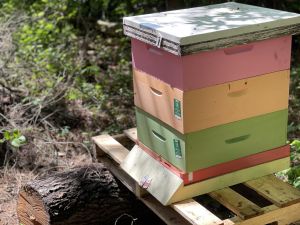
Beehive Kit: There are tons of options and sizes. These kits will include frames, base, inner cover and outer cover.
Huge Learning Point: Frame foundation is crucial. You may be able to get away with saving some cash on some items, but heavy waxed (fame) foundation is worth spending money on. I have learned that the speed at which comb is drawn is definitely related to the quality of waxed foundation.
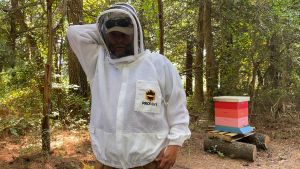
Bee Suit & Veil: Protects you from stings. You can go simple, or you can go all out. We chose to go with a jacket style and gloves. Your choice depends on your comfort level with the bees. Some people choose a full suit, while more experienced beekeepers go with just a veil.
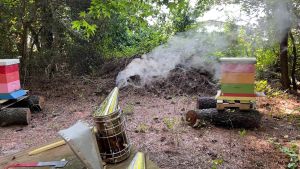
Smoker: Calms bees for inspection. The art of the smoker is getting it lit and going in a timely manner. You’ll also have to choose what fuel you will use. Some roll up burlap and others use natural materials. We have tons of dry pine needles, so some paper and pine needles are our go to. Recently, we started using B-Calm and it seems to work ok.
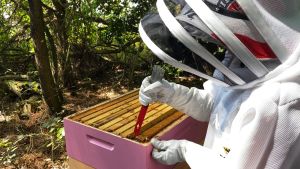
Hive Tool: Used to separate and lift frames. Get a couple, I seem to misplace them often
Feeder: Feeders were another learning point for us. At first, we didn’t think about having to feed bees, that resulted in a mad dash for feeders. We went with Bucket Style Bee Feeders. Also, buy stock in a sugar company.

Testing – Traps -Treatment: Another thing we did not expect was the necessary focus on Varroa Mites and Small Hive Beetles. Testing for mite levels and treating accordingly has become a focus. We get small hive beetles consistently due to our property being wooded.
Honey Extractor: Spins honey from frames. Why do all this work and not reap the rewards. Don’t forget strainers, filters, buckets and jars.

Beekeeping Books and Mentors: Ok, books and mentors are probably not equipment, but give me a break, I didn’t have anywhere else to put this. Get some beekeeping books. Subscribe to some YouTube channels. Find a mentor, local or online. There is a lot to learn about keeping beehives. Check out David Burns for books, classes and mentorship opportunities.
Getting Started with Beekeeping: The Annual Cycle
Now listen, the United States is pretty large with a wide range of climates, topography, flowers, plants and vegetables. Basically, what we are saying is that you need to tweak this information for your specific region. The basic annual cycle is below.
Beekeeping in the Spring: Lets Go
The days are getting longer and warmer and we want to get rolling. We have been dying to get in the hives and the bees have been dying to get out. Spring lays the foundation for your year. We have splits, nucs, packages, inspections and swarm control to manage.
Summer Beekeeping: Busy Bees
Bees are super busy in the summer. Early summer they are at the peak population numbers in the hive and resources are flowing in. If we are lucky, we’ll get a good honey harvest. This is a time to do inspections to keep an eye out for swarming and pests. You might even have to think about late season feeding if the nectar and pollen flow start to drop off.
Keeping Beehives in the Fall: Survival Prep and Treatments
Cooler temperatures and shorter days usher in a switch in the colony from expansion to winter survival preparations. Bees and beekeepers are making sure there is enough but not too much honey. Total bee numbers decrease with available resources dwindling. It is also a great time to remove any suppers to make sure there are enough bees to heat the hive during the winter. Don’t forget to close up those bottom boards. You may need to start / keep feeding and fall is a great time to treat for Varroa Mites.
Beehives in the Winter: The Beekeepers Balancing Act
Winter months are some what of a balancing act. Monitor for health, but try not to disturb the bees. Keep the hive warm, but don’t forget about ventilation to lessen the risk of condensation. I was once told a little piece of information to remember. Cold bees are bad, cold wet bees are dead. Keep an eye on food stores and be ready to feed fondant. Winter really boils down to monitoring your hives.